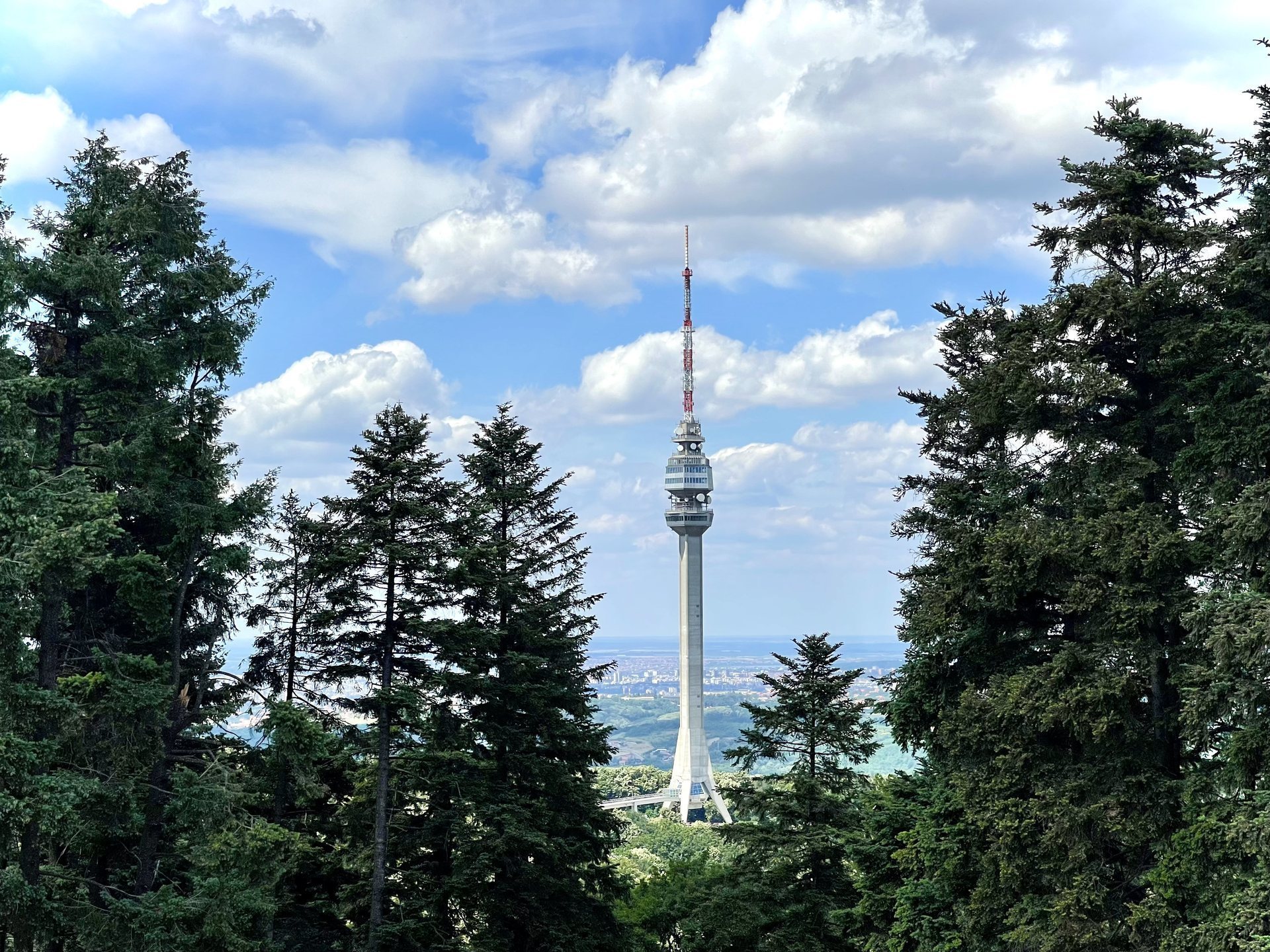
Most television towers are round. Belgrade’s stands on three legs, like the three-legged stool, the tronožac, found in every old Serbian farmhouse, and its shaft is an equilateral triangle in section. On a clear day you can see it from the city, sixteen kilometres away on the top of Mount Avala: a grey exclamation mark at the end of the skyline.
The design
The architects were Uglješa Bogunović and Slobodan Janjić, and the structure was designed by the engineer Milan Krstić, a member of the Serbian Academy of Sciences and Arts whose speciality, fittingly, was the stability of thin-walled shells. Krstić based the whole structure on the equilateral triangle, the shape that will not fold.
 Photo creditMiomir Magdevski, CC BY-SA 4.0, via Wikimedia Commons
Design and foundations took shape in 1959 and 1960, and the shaft rose in 1963 and 1964 in hydraulic slip-forms, the concrete poured continuously as the formwork crept upwards. The Belgrade firm GP Rad built it, and on 14 May 1965 the tower went into service, 202.87 metres tall.
Its feet are startlingly shallow. The legs rest on concrete blocks set into Avala’s solid rock, only about 1.2 metres deep: the tower stood by balance and by the mountain, not by burrowing into it. High up, the city archive records a six-sided “floating” restaurant at 118 metres, with telescopes trained on Belgrade.
29 April 1999
On the night of 29 April 1999, during the NATO bombing, one of the three legs was hit and the tower collapsed. A tripod cannot stand on two legs, which was always the price of its elegance. For several years Avala had only a stump and the summit felt bare.
Built again
The campaign to rebuild, Izgradimo toranj (“Let’s build the tower”), drew more than a million people: postcards, concerts, donations, and a charity tennis match between Novak Đoković and Ana Ivanović. The new tower was designed by the Belgrade engineering institute CIP and built by Ratko Mitrović Dedinje; work on the shaft began in the winter of 2006–07, and it was officially opened on 21 April 2010.
It is faithful to the original in form but not in muscle. The new tower uses stronger MB 50 concrete, weighs nearly 6,000 tonnes, about half as much again as its predecessor, and is designed for winds of 200 kilometres an hour. It is also a little taller, at 204.5 metres. Two Schindler lifts climb at three metres a second and reach the open lookout, at 122 metres, in 38 seconds.
Legacy
The tower is one of a family of concrete transmission towers built across Yugoslavia, but none had a story like this. Its operator calls it the pride of all Belgraders, and the numbers bear it out: more than 160,000 visitors a year by its count in 2017, and up to 5,000 on a summer weekend. Few buildings are loved enough to be paid for twice.
 Photo creditMiomir Magdevski, CC BY-SA 4.0, via Wikimedia Commons
See it for yourself
Go on a clear morning and stand on the lookout facing north: Belgrade, the rivers and the plains of Vojvodina lie flat to the horizon. On the summit nearby stands Ivan Meštrović’s Monument to the Unknown Hero, finished in 1938, and the forest paths between the two make the best half-day out of the city.