Belgrade has two rivers and a long memory, and its bridges are where the two meet. Few cities have had to build their crossings so often; few have used the opportunity so well. A bridge engineer can read the city’s whole twentieth century in the spans across the Sava, each one a little bolder than the last.
The bridge with nine lives
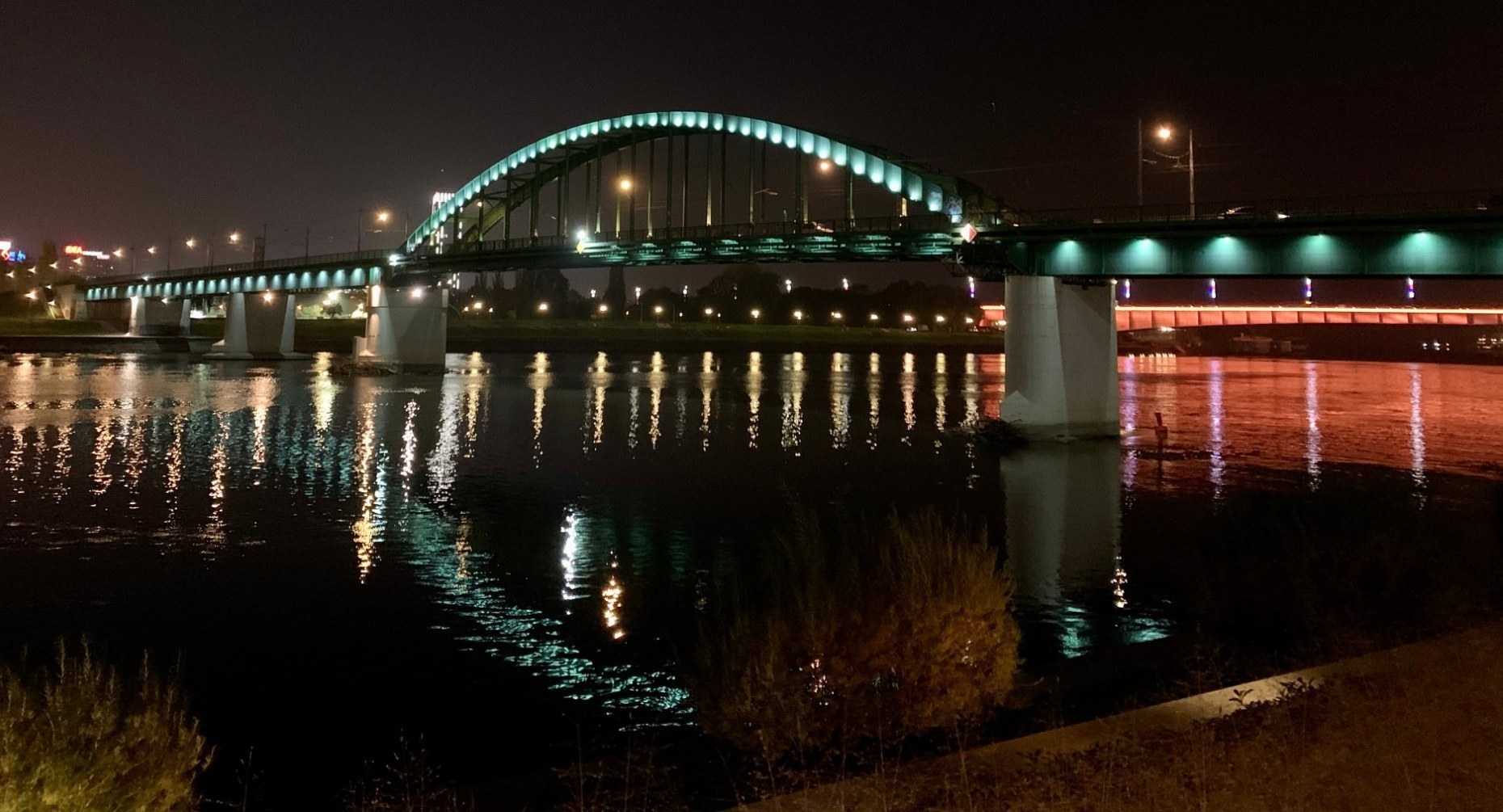
The first was the railway bridge of 1884, which carried Serbia’s first trains across the Sava to Zemun, then in Austria-Hungary. Blown up and rebuilt again and again through two world wars, it saw its last train in 2018. Its next life is gentler: a plan by Mostprojekt raises the whole steel structure by 2.6 metres to clear river traffic and turns it into a walking and cycling bridge, with cafés and lookouts over the water.
A world record, in 1956
Branko’s Bridge, the one every visitor crosses between the old town and New Belgrade, stands on the piers of the King Alexander suspension bridge of 1934. Its steel box girder, built by the German firm MAN and opened in 1956, spans 261 metres in one leap, and at its opening it was the longest-span beam bridge in the world. A second, parallel deck was added in 1979.
Gazela, the motorway bridge just upstream, was designed in 1962–63 by a team led by Professor Milan Đurić and completed in December 1970: a steel frame whose slanting legs span about 250 metres and look, as the name suggests, like a gazelle in mid-leap. The concrete pillars beneath it now double as an open-air gallery of murals.
A first for the trains
In 1979 came the New Railway Bridge by Nikola Hajdin and Ljubomir Jevtović, a cable-stayed bridge with a main span of 254 metres. It was the first cable-stayed bridge in the world built only for railway traffic. It is still carrying them.
 Photo creditMiomir Magdevski, CC BY-SA 4.0, via Wikimedia Commons
Hajdin, later president of the Serbian Academy of Sciences and Arts, also designed the Liberty Bridge over the Danube in Novi Sad. Thirty years after his railway bridge he chaired the jury that chose the Ada Bridge, which stands upstream within sight of it.
The Danube crossings
The Danube, about a kilometre wide at Belgrade, has fewer bridges. The Pančevo Bridge carries road and rail to the Banat, and in 2014 the Pupin Bridge between Zemun and Borča, named after the physicist Mihajlo Pupin, opened a second crossing upstream.
The bridges on their way
Beside Belgrade Waterfront, the German-built Old Sava Bridge of 1942 was lifted away in 2025 by the floating crane Adam Clark. In its place a new steel arch is rising: 420 metres long, with a main span of 166 metres, carrying trams in the middle, cars either side and wide paths with viewing terraces. Its first steel arrived by a convoy of seven barges in November 2025, and it is due to open in 2027.
Downstream, a third road bridge over the Danube at Ada Huja, about 3.5 kilometres long with its approaches, has received its environmental permit and is moving towards construction. Seventy years after planners first drew it, it is now a matter of when.
See it for yourself
Walk the Sava quay in New Belgrade from Branko’s Bridge to the Ada Bridge, about an hour, and you will pass four generations of engineering. Then take a river cruise from the quay below the fortress and see them as the engineers intended: from underneath.