- Belgrade-born, trained as an architect: his bodies run across grids, scales and construction lines.
- Paris from 1966, professor at the Beaux-Arts, and in 2005 elected to the Académie des beaux-arts in Bernard Buffet’s seat.
- His drawing prize for young Serbian artists, run with Galerija Haos, is still awarded in Belgrade.
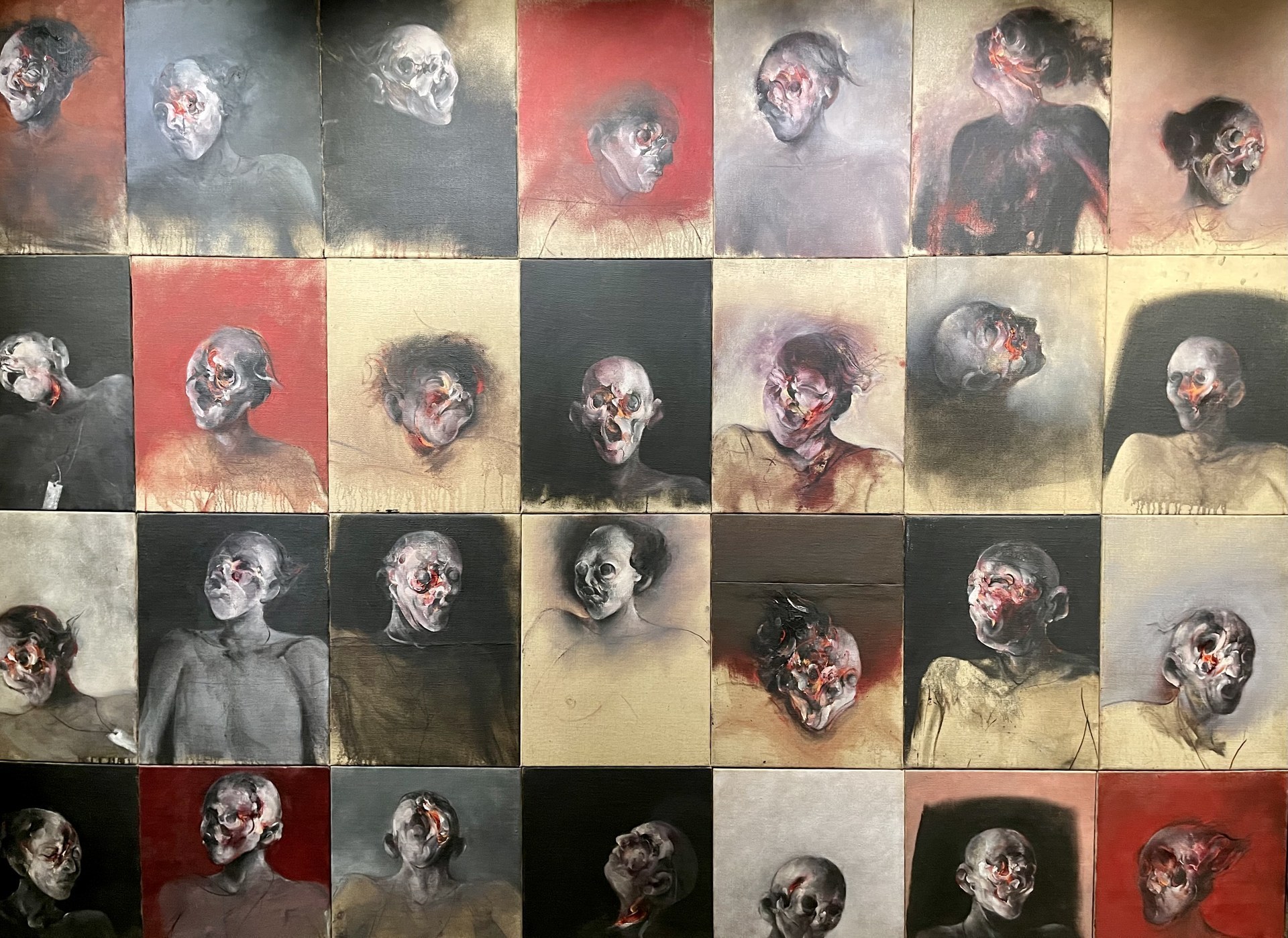
Stand in front of a wall of Vladimir Veličković’s heads and the heads stand in front of you: rows of them, on red, black, grey and cream, mouths open, skulls showing through the skin like scaffolding through a ruin. Nobody poses. Nobody smiles. It is a portrait gallery of the moment just after something has gone terribly wrong.
It is also, unmistakably, the work of a man who first learned to draw buildings.
A teenager with a borrowed age
Veličković was born in Belgrade on 11 August 1935. He first showed his work in 1951, at sixteen, at the Cvijeta Zuzorić Art Pavilion, in a competition meant for established painters. According to the Faculty of Contemporary Arts, where he later taught, he kept quiet about his age to get in. Belgrade art history is full of rules; this was one of the first he broke.
He then did the sensible thing and studied architecture, graduating from the Faculty of Architecture in Belgrade in 1960. In 1962 and 1963 he joined Krsto Hegedušić’s master workshop in Zagreb, and in 1963 he held his first solo exhibition and took the painting award at the October Salon. The sensible career lasted about as long as it took to say so.
The grid that never left
Look closely at almost any large Veličković and the architect is still at the drawing board. Figures run across fields of numbers and scales; a dog leaps over a black ground ruled with construction lines; bodies are laid out like sections and elevations. Tate in London holds a work of 1979 whose title says it plainly: Elements and Documents Employed.
The effect is unsettling because it is so orderly. The violence in the pictures is never chaotic. It is measured, plotted and filed, as if the twentieth century had commissioned a technical survey of its own cruelty and handed the job to the one draughtsman who would not look away.
Paris, and the Académie
In 1965 he won the painting prize at the Paris Biennale, and in 1966 he moved to Paris for good. A show at the Galerie du Dragon in 1967 made his name, and he became one of the leading painters of the Figuration narrative, the French movement that put the figure, and the news, back into painting. Prizes followed at the Nadežda Petrović Memorial in 1968 and 1978, and at the São Paulo Biennale in 1977.
In 1983 he became a professor at the École nationale supérieure des Beaux-Arts in Paris and taught there until 2000. On 7 December 2005 he was elected to the painting section of the Académie des beaux-arts, in the seat of Bernard Buffet: the first Franco-Serbian artist to sit under the famous dome. France also made him a Chevalier of the Légion d’honneur and a Commandeur of the Ordre des Arts et des Lettres.
Dogs, rats, crows and the rest of us
His bestiary is small and loyal. Dogs run, rats swarm, crows gather on a wire under a sky the colour of wet cement. The human figure shares the canvas with them on equal and uncomfortable terms. The Académie described his world as macabre and aggressive, a meditation on the suffering people inflict on one another, which is accurate and still somehow undersells how beautifully it is painted.
The palette is spare: blacks, bone whites, dried-blood reds, a grey that seems to have been mixed from ash. Against it a single slash of red reads like an alarm. The drawing is relentless, and the paint often looks as though it has been pulled across the canvas rather than laid on.
Belgrade kept the door open
Paris had his address; Belgrade kept his name. He was an external member of the Serbian Academy of Sciences and Arts, which showed his work in its gallery on Knez Mihailova in 1986, 2002 and 2013. In 2007 he was commissioner of the Serbian Pavilion at the Venice Biennale, and from 2006 he taught at Belgrade’s Faculty of Contemporary Arts, where he mentored five doctoral candidates.
By the end he had held more than a hundred solo exhibitions, his work sat in public and private collections in about twenty-five countries, and the Serbian Academy counted twelve documentaries and fifteen monographs about him. For a painter of such difficult pictures, that is a remarkable amount of attention. People kept looking, which was rather the point.
What he left to the young
In 2009 he set up a fund for drawing in his name to reward young Serbian artists, run with Galerija Haos under the patronage of the Serbian Academy of Sciences and Arts. The prize is still awarded, and the laureates are shown in Belgrade. It is a fitting legacy for a painter who believed everything began with the line.
Veličković died in Split on 29 August 2019. His pictures have not softened since. They still ask the question a good building asks of the people who walk through it: what are we made of, and how much can we bear?
See it for yourself: look for his work at the Gallery of the Serbian Academy of Sciences and Arts on Knez Mihailova and at Galerija Haos, and at the group exhibition at Dom omladine curated by Numa Hambursin, which includes him among its artists until 13 December. Exhibitions change, so check what is on before you go.