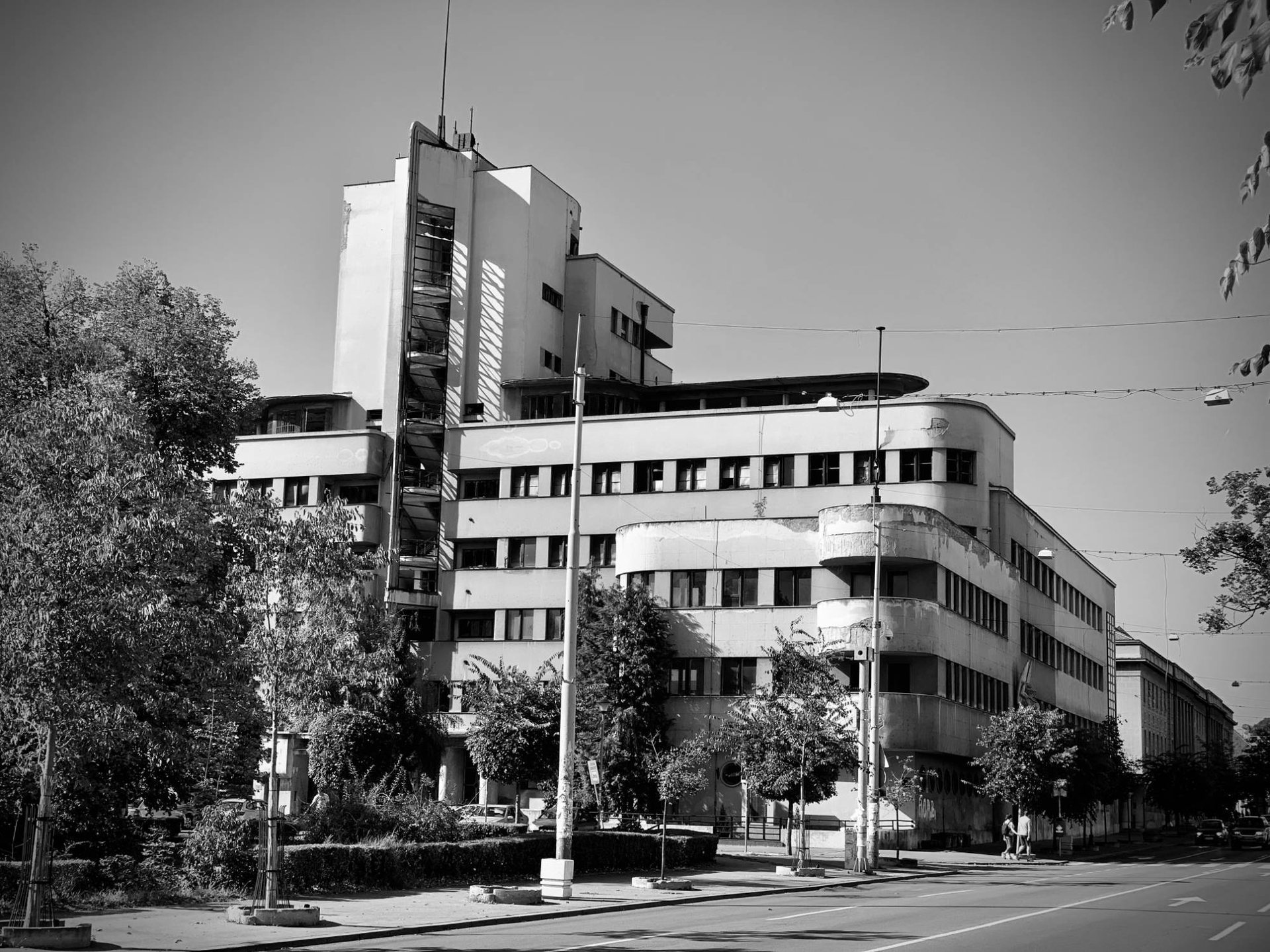
In old Zemun, among Habsburg cornices and merchants’ houses, a modernist tower rises in steps like a ship’s bridge, or an aircraft lifting off. That was the point.
A headquarters for the sky
In the 1930s the Royal Yugoslav Air Force was one of the most modern institutions of the young kingdom, and it wanted a headquarters to match. The site was in the heart of old Zemun, on the land of the former Military Command beside Glavna Street, and the commission went to Dragiša Brašovan, one of the leading architects of Yugoslav modernism.
Steps to the sky
Completed in 1935, the building was hailed as one of the most beautiful and monumental in the country. A four-storey block around an inner courtyard is crowned by a seven-storey tower of stepped volumes. Milutin Milanković, the scientist who worked out how slow changes in the Earth’s orbit bring on the ice ages, made the structural calculations, and Zlata Markov’s Icarus on the side facade is a sculpture with a dry sense of humour about flying.
The architect
Brašovan (1887–1965), born in Vršac, designed the Yugoslav pavilion at the 1929 Barcelona International Exposition, one of the few avant-garde pavilions there alongside Mies van der Rohe’s, as well as the State Printing House in Belgrade, later BIGZ, and the Banovina Palace in Novi Sad. In the 1950s he rebuilt a youth headquarters on Bulevar kralja Aleksandra into the Metropol, the hotel that became Belgrade’s window on the world.
Paintings where the pilots were
The building is the most important modernist work in old Zemun and a protected cultural monument. Inside, the Dom vazduhoplovstva aviation club runs Galerija Ikar, with changing exhibitions and an international watercolour festival every late summer, so a building made for pilots now hangs paintings.
How to see it
From the street, on a walk between the Zemun quay and Gardoš. Stand across Glavna and let the tower do what Brašovan asked of it: take off, without ever leaving the ground.